Author: user

  • Understanding Your Travis County Property Appraisal: Key Factors That Influence Your Home’s Value

    Understanding Your Travis County Property Appraisal: Key Factors That Influence Your Home’s Value

    Short answer: Travis County property appraisals are primarily influenced by recent market sales of comparable homes, your property's specific characteristics like size, age, and features, and broader economic trends. Legal protections, such as the homestead exemption and the 10% appraisal cap for homesteads, also significantly affect your taxable value, often creating a gap between your home's market value and its assessed value for tax purposes.

    • Market sales are TCAD's primary valuation method.
    • Property features greatly impact your home's value.
    • Homestead exemptions reduce your taxable assessment.
    • The 10% cap limits annual homestead appraisal increases.
    • Equal and uniform appraisal is a powerful protest right.
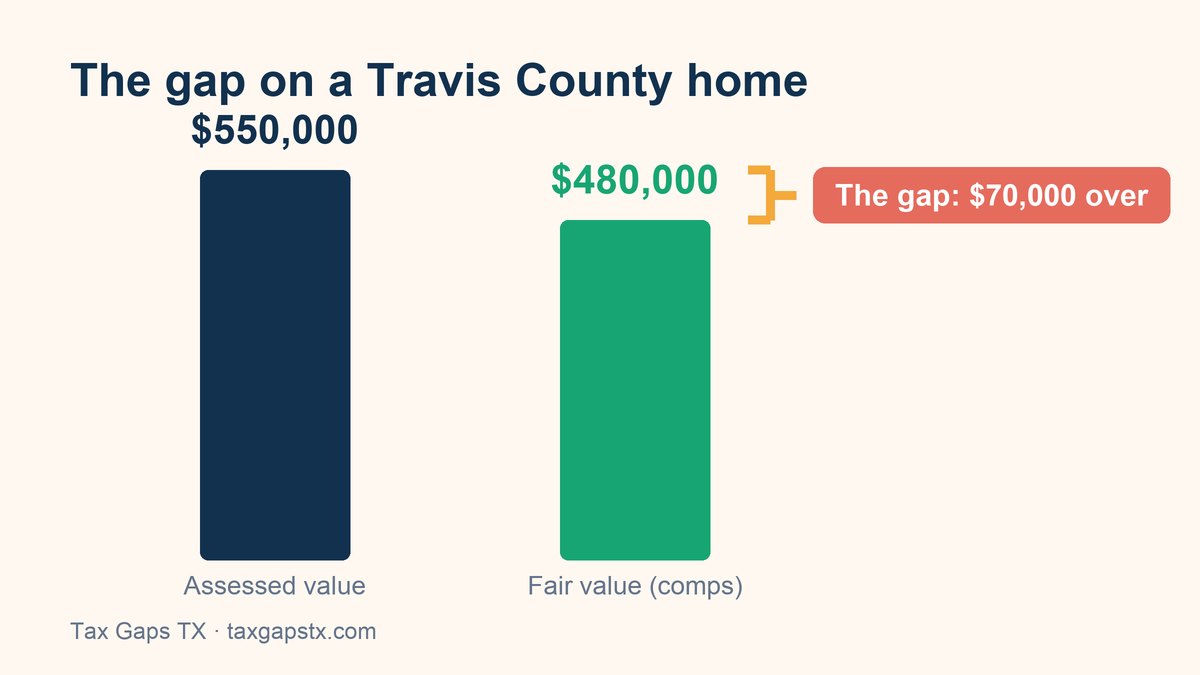
    Assessed value vs fair value — the gap you may be overpaying
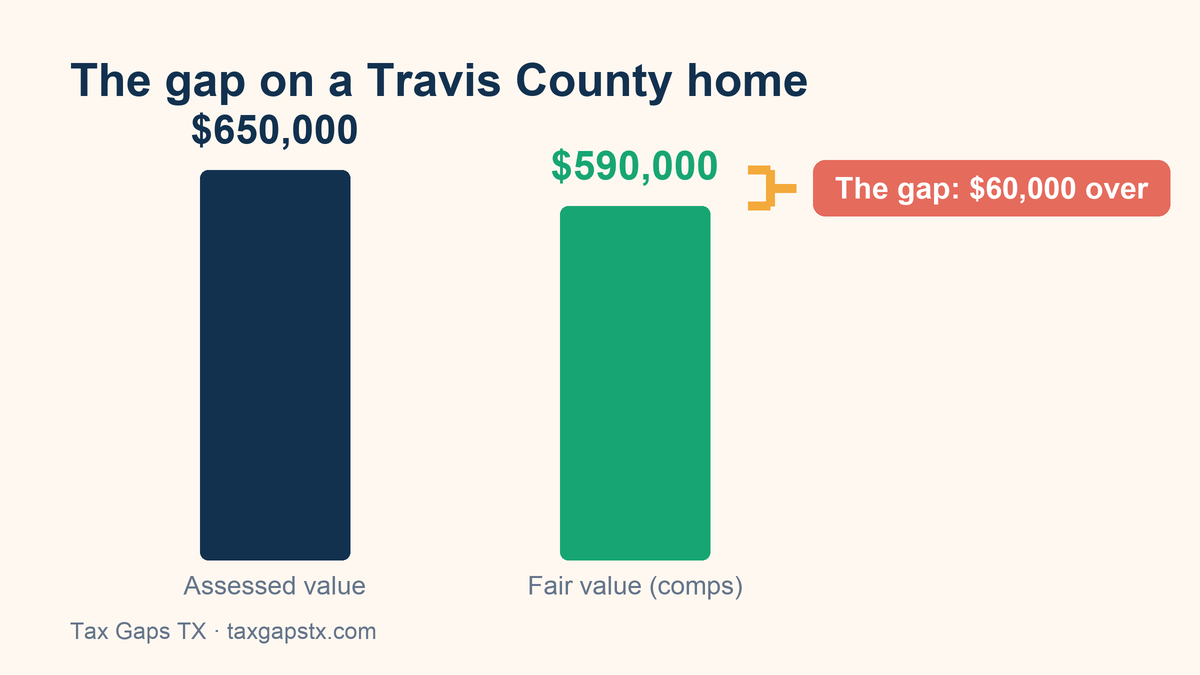
    The “gap” is what you may be over-assessed — and the basis for a protest.

    How Does the Travis Central Appraisal District (TCAD) Value Your Home?

    The Travis Central Appraisal District (TCAD) is tasked with valuing all properties in Travis County each year. Their goal is to estimate your home’s market value – what it would likely sell for on January 1st of the tax year. This estimate forms the basis for your property taxes. However, understanding the factors they consider can help you determine if their valuation is fair, or if your property might be over-assessed.

    The Core Factor: Recent Market Sales of Comparable Homes

    By far, the most significant factor TCAD uses to appraise your home is the recent sales data of similar properties in your neighborhood. This is known as the ‘sales comparison approach.’ TCAD analysts review homes that have recently sold and attempt to compare them to yours, making adjustments for differences. However, the challenge for homeowners often lies in whether TCAD is selecting the truly most comparable sales, or if they’re making appropriate adjustments for variations in features, condition, or location. Sometimes, they might miss sales that would indicate a lower market value for your property.

    Your Property's Unique Characteristics and Features

    While market sales provide the baseline, your home’s specific attributes play a crucial role in its individual valuation. TCAD considers a range of characteristics, including:

    • Physical Size: Square footage of living space, lot size.
    • Age and Condition: The year your home was built, its overall condition, and any recent major renovations or deferred maintenance.
    • Construction Quality: Materials used (e.g., brick, siding), foundation type.
    • Number of Rooms: Specifically bedrooms and bathrooms.
    • Amenities: Features like a swimming pool, detached garage, covered patio, upgraded kitchens or bathrooms.
    • Location within the Neighborhood: Factors like being on a busy street, adjacent to a greenbelt, or having desirable views can influence value.

    Any discrepancies in these factors between your home and the comparable sales TCAD uses can lead to an inaccurate appraisal.

    Broader Economic Conditions and Local Development Trends

    Beyond individual property features, larger economic forces and local development trends in Travis County can influence overall property values. These include:

    • Interest Rates: Higher interest rates can reduce buyer purchasing power, potentially slowing market appreciation.
    • Job Growth and Population Shifts: A strong local economy and increasing population typically drive up demand for housing.
    • New Developments and Infrastructure: New schools, parks, or transportation improvements can make an area more desirable and increase property values.
    • Supply and Demand: The number of homes for sale versus the number of buyers can significantly impact pricing.

    While homeowners have little control over these factors, they contribute to the general market conditions that TCAD observes.

    Legal Protections That Limit Your Taxable Value

    Even if your home’s market value increases, certain Texas laws can protect you from the full impact of that increase on your property taxes. These protections often create the ‘gap’ where your assessed value for tax purposes is lower than the full market value.

    • Homestead Exemption: If your home is your primary residence, a homestead exemption reduces the taxable portion of your home’s value, lowering your tax bill.
    • 10% Appraisal Cap: For properties with an approved homestead exemption, Texas law limits how much your appraised value can increase each year to a maximum of 10% (plus the value of any new improvements). This cap applies to the assessed value, not necessarily the market value.
    • Equal and Uniform Appraisal (Texas Tax Code 41.43(b)(3)): This is a powerful right. It means your property should not be assessed at a higher value than comparable properties in your area, taking into account equity and uniformity. If similar homes are assessed for less than yours, you have a strong case for protest.

    If you suspect your home’s assessed value is higher than comparable properties, that’s your ‘equal and uniform’ gap. Our free tool at Tax Gaps TX can help you quickly check your estimated over-assessment for Travis County by analyzing public appraisal data and identifying lower-assessed comparable homes near you. Visit app.taxgapstx.com/check to get started.

    What to Do If You Disagree with Your TCAD Appraisal

    Understanding these factors is the first step. If you believe your Travis County property appraisal is too high based on market conditions, your home’s features, or the ‘equal and uniform’ principle, you have the right to protest. The standard deadline to file a protest is May 15th or 30 days after your Notice of Appraised Value is mailed, whichever is later. Always confirm the exact date for your property with TCAD. Gathering evidence, such as sales of truly comparable homes assessed at a lower value, is key to a successful protest.

    Key Texas Property Tax Exemptions for Homeowners

    Exemption Type Who Qualifies Benefit Important Note
    General Homestead Exemption Your primary residence (owner-occupied) Reduces your home's taxable value (e.g., by $100,000 for school taxes and 20% for other taxes in 2026). Must apply by April 30th after purchasing or establishing residency. Check current amounts with TCAD.
    Over-65 or Disabled Homestead Exemption Owners aged 65+ or certified as disabled, who also qualify for a general homestead. Provides additional tax ceiling and reduction in taxable value (varies by taxing unit). Apply once you turn 65 or receive disability status. Can be combined with general homestead.
    Disabled Veterans Exemption Veterans with a service-connected disability (percentage matters). Varies from $5,000 to 100% exemption on your home, depending on disability rating. Must apply with your local appraisal district. 100% disabled veterans may be fully exempt.

    Check your home in minutes

    Tax Gaps TX has a free home check at app.taxgapstx.com/check — enter your address and, in about a minute, see your estimated over-assessment gap for Travis (TCAD) or Dallas (DCAD) county, based on public appraisal data and comparable homes assessed for less than yours. A specialist can then walk you through the evidence and whether it's worth protesting.

    Find your gap free →

    Frequently asked questions

    How often does TCAD appraise my property?

    TCAD appraises all properties in Travis County annually. You will receive a Notice of Appraised Value each spring, usually around April.

    Can I see the comparable sales TCAD used for my home?

    Yes, your Notice of Appraised Value should include information on how to access the property characteristics and comparable sales data TCAD used. You can also typically find this on the TCAD website by searching for your property.

    What is the 10% appraisal cap?

    The 10% appraisal cap limits how much your assessed value can increase each year if you have an approved homestead exemption. Even if your home's market value goes up by more than 10%, your assessed value for tax purposes cannot exceed a 10% increase over the previous year's assessed value, plus the value of any new improvements.

    When is the deadline to protest my Travis County appraisal?

    The general deadline to protest your Travis County property appraisal is May 15th, or 30 days after TCAD mails your Notice of Appraised Value, whichever date is later. It's crucial to verify your specific deadline directly with TCAD.

    What is 'equal and uniform' appraisal?

    The 'equal and uniform' principle (Texas Tax Code 41.43(b)(3)) states that your property should not be appraised at a higher value than the average appraisal of similar properties in your neighborhood. This is a common and effective basis for protest if you can identify comparable homes assessed at a lower value than yours.

    Tax Gaps TX provides general information, not legal, tax, or financial advice. Deadlines and exemption amounts change; confirm current figures with your county appraisal district or the Texas Comptroller.

  • 5 Signs Your Texas Home Might Be Over-Assessed for Property Taxes

    5 Signs Your Texas Home Might Be Over-Assessed for Property Taxes

    Short answer: Your Texas home might be over-assessed if its appraised value is higher than similar homes nearby, recent sales data shows lower values, or your homestead exemption cap wasn't applied. Other signs include errors in your appraisal district's records or an assessed value that doesn't reflect your home's actual condition. Identifying these can lead to a successful property tax protest.

    • Your assessed value is higher than comparable nearby homes.
    • Recent sales prices in your area are lower than your home's assessment.
    • The 10% homestead cap was incorrectly applied, or you lack an exemption.
    • The appraisal district's records for your property contain factual errors.
    • Your home's condition (e.g., age, repairs needed) isn't reflected in its value.
    • You haven't checked your property's assessment or protested in years.
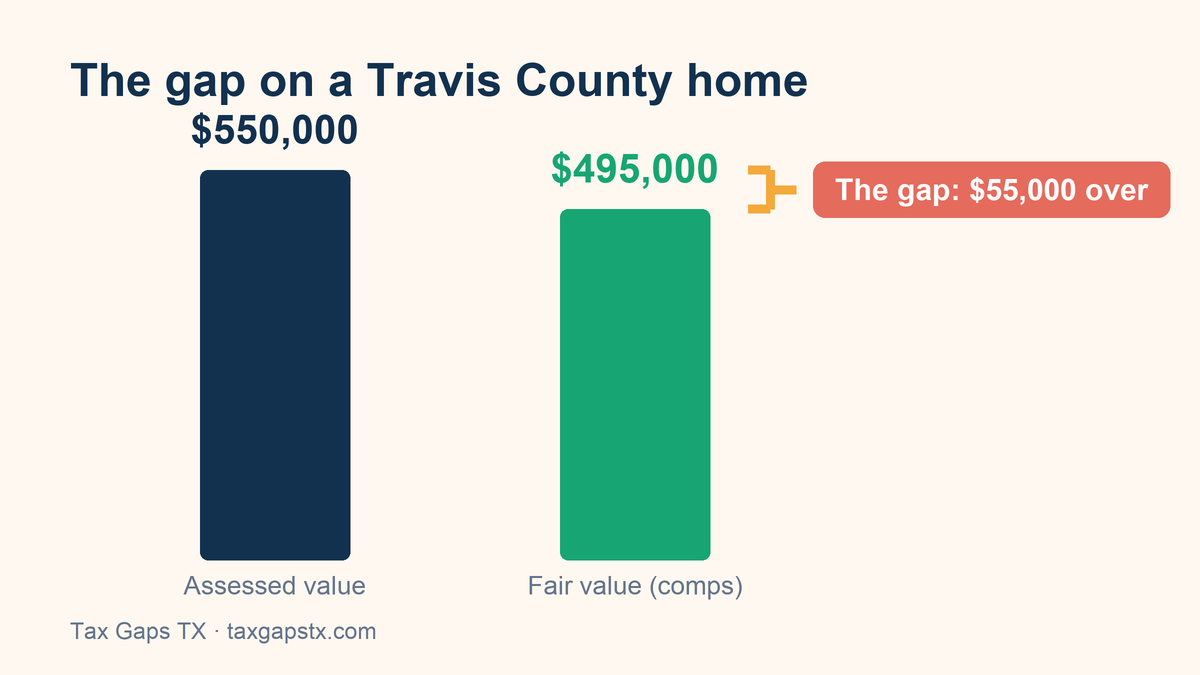
    Assessed value vs fair value — the gap you may be overpaying
    The “gap” is what you may be over-assessed — and the basis for a protest.

    How Does Property Assessment Work in Texas?

    In Texas, county appraisal districts (like TCAD in Travis County or DCAD in Dallas County) are tasked with appraising all properties at their market value as of January 1st each year. This market value is then used to calculate your property taxes. However, for homestead properties, there’s a crucial protection: the appraised value used for taxation can’t increase by more than 10% per year, regardless of how much the market value might jump. This is known as the homestead cap.

    The appraisal district aims for ‘fair and equitable’ appraisals, meaning your home should be valued similarly to comparable properties in your area. Sometimes, however, their data or methods can lead to an over-assessment, leaving a ‘gap’ between what they say your home is worth and its actual value.

    Sign 1: Your Assessed Value is Higher Than Similar Homes Nearby

    This is often the most compelling sign of over-assessment. Texas Tax Code Section 41.43(b)(3) allows you to protest if your property is appraised at a value greater than the average value of comparable properties, an argument known as ‘equal and uniform’ appraisal. If homes similar in age, size, condition, and location to yours are assessed for less, you likely have a strong case.

    You’ll want to gather evidence of these comparable properties. This means looking at houses that have similar square footage, lot size, number of bedrooms and bathrooms, and are located within your neighborhood or a very close, similar one. Comparing your home’s assessed value to these comps is the cornerstone of a successful protest. Our free tool at Tax Gaps TX can help you pull public appraisal district data for Travis and Dallas counties, identify comparable homes assessed for less than yours, and reveal your equal-and-uniform gap.

    Sign 2: Recent Sales in Your Neighborhood Are Lower Than Your Assessment

    The appraisal district bases its valuations on market data, but sometimes their data can be outdated or incomplete. If several homes similar to yours have recently sold for less than your property’s appraised value, it’s a clear indicator that your assessment might be too high. This reflects the true ‘market value’ of homes in your area.

    Keep an eye on local real estate listings and sales records. Real estate agents often provide comparative market analyses, which can be invaluable evidence. Remember, the appraisal should reflect the market value as of January 1st of the tax year (e.g., January 1, 2026, for the 2026 tax year), so focus on sales data around that period.

    Sign 3: Your Homestead Cap Wasn't Applied Correctly (or You Don't Have an Exemption)

    For homeowners who have an approved homestead exemption on their primary residence, Texas law limits the annual increase in their appraised value for tax purposes to 10%. If your appraised value for the 2026 tax year increased by more than 10% over last year’s *appraised value for tax purposes* (not market value), and you have a homestead exemption, this could be an error.

    Furthermore, ensure you’ve applied for all eligible exemptions, such as the general residence homestead exemption, over-65, or disabled veteran exemptions. These can significantly reduce your taxable value. Always verify your exemption status with your county appraisal district (e.g., TCAD or DCAD) directly, as deadlines and requirements can change yearly.

    Sign 4: Your Appraisal District Records Contain Errors

    Appraisal districts manage millions of property records, and mistakes happen. Simple errors in your property’s characteristics can lead to an inflated appraisal. Check your appraisal district’s online records for accuracy. Look for details such as:

    • Incorrect square footage of your home or lot
    • Wrong number of bedrooms or bathrooms
    • Misstated features like a pool, garage, or recent additions
    • Incorrect age of the home or structural details
    • Mistakes in your property’s condition (e.g., listed as ‘excellent’ when it needs significant repairs)

    These seemingly small inaccuracies can add up, making your property seem more valuable than it is. Correcting these factual errors is often one of the easiest ways to get your assessment reduced.

    Sign 5: Your Home's Condition Doesn't Match Its Assessment

    If your home is older, requires significant maintenance, or has features that are less desirable than newer constructions in your area, its assessed value should reflect these realities. For instance, if your kitchen and bathrooms are original from the 1970s while neighbors have recently remodeled, your home’s value should be lower.

    The appraisal district might not have current interior information or might be unaware of deferred maintenance. Documenting these issues with photos and estimates for repairs can serve as strong evidence that your home’s current condition warrants a lower valuation compared to well-maintained or recently updated properties.

    What Should You Do If You Suspect Over-Assessment?

    If you identify any of these signs, don’t just pay the higher tax bill. You have the right to protest your property appraisal. The standard deadline to file a protest is May 15th, or 30 days after your Notice of Appraised Value is mailed to you, whichever is later. Always confirm the exact deadline with your specific county appraisal district (e.g., TCAD for Travis County, DCAD for Dallas County) for the current tax year (2026).

    The protest process typically involves an informal review with an appraisal district representative, followed by a formal hearing with the Appraisal Review Board (ARB) if an agreement isn’t reached. For high-value properties, binding arbitration might be an option. The key is to gather solid evidence, such as comparable sales, photos of your home’s condition, and corrected property data. While we can provide general information, this is not legal, tax, or financial advice; always consult official sources or professionals for specific guidance.

    Ready to see if you have a gap? Our free tool at app.taxgapstx.com can help you quickly check your home’s assessment against comparable properties in Travis and Dallas counties.

    Key Factors to Compare When Suspecting Over-Assessment

    Factor to Check What to Look For Why it Matters for Protest
    Assessed Value vs. Comps Your assessed value is higher than similar homes (size, age, features) nearby. Supports an 'equal and uniform' appraisal argument (Texas Tax Code 41.43(b)(3)).
    Recent Sales Data Similar homes in your neighborhood have sold for less than your assessed value. Indicates your property's market value may be lower than the appraisal.
    Property Details/Errors Inaccurate square footage, number of rooms, lot size, or features in CAD records. Factual errors can inflate your assessment; easy to correct with proof.
    Homestead Exemption & Cap Your homestead cap wasn't applied, or your value increased over 10% with a cap. Essential protection for primary residences; incorrect application means over-taxation.
    Home Condition Your home needs significant repairs, is outdated, or is in poorer condition than assessed. Physical condition directly impacts market value; CAD may be unaware of issues.

    Check your home in minutes

    Tax Gaps TX has a free home check at app.taxgapstx.com/check — enter your address and, in about a minute, see your estimated over-assessment gap for Travis (TCAD) or Dallas (DCAD) county, based on public appraisal data and comparable homes assessed for less than yours. A specialist can then walk you through the evidence and whether it's worth protesting.

    Find your gap free →

    Frequently asked questions

    What is the 10% homestead cap in Texas?

    The 10% homestead cap limits the annual increase in your home's appraised value for tax purposes to no more than 10% over the previous year's appraised value, provided you have an approved homestead exemption on your primary residence. This helps protect homeowners from sudden, large tax increases.

    How do I find comparable properties to protest my assessment?

    You can find comparable properties by checking your county appraisal district's public records online, looking at recent sales data from real estate websites, or using tools like the free one at Tax Gaps TX. Focus on homes similar in size, age, condition, and location that have lower assessed values or recent sales prices.

    What is the deadline to protest my property taxes in Texas for 2026?

    The standard deadline to protest your 2026 property taxes in Texas is May 15, 2026, or 30 days after your county appraisal district (e.g., TCAD or DCAD) mails your Notice of Appraised Value, whichever date is later. It's crucial to confirm the exact deadline with your specific appraisal district.

    Can I protest my property taxes every year?

    Yes, you have the right to protest your property appraisal every year in Texas, even if you were successful in a previous year. Property values and market conditions change annually, so it's a good practice to review your appraisal notice and protest if you believe your home is over-assessed.

    Tax Gaps TX provides general information, not legal, tax, or financial advice. Deadlines and exemption amounts change; confirm current figures with your county appraisal district or the Texas Comptroller.

  • How Texas Appraisal Districts Calculate Your Home’s Value

    How Texas Appraisal Districts Calculate Your Home’s Value

    Short answer: Texas appraisal districts calculate home values using mass appraisal techniques, primarily focusing on recent sales data of comparable homes in your area to determine market value. They also consider property characteristics, replacement costs, and sometimes income for rental properties. While aiming for fair market value, these methods can lead to over-assessments, making it important for homeowners to review their annual appraisal notice carefully.

    • Appraisal districts use mass appraisal methods.
    • Market value is the goal, based on comparable sales.
    • Homesteads have a 10% assessed value cap.
    • Equal and uniform assessment is your right.
    • Review your appraisal notice annually.
    • Protest if your home is over-assessed.
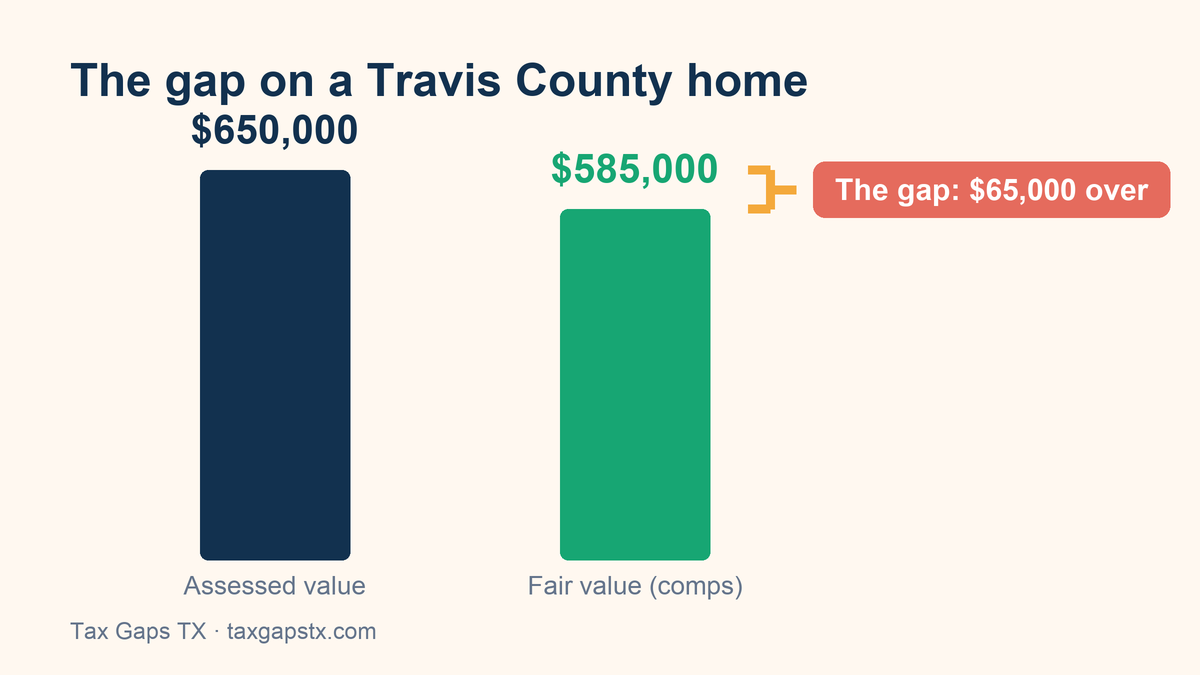
    Assessed value vs fair value — the gap you may be overpaying
    The “gap” is what you may be over-assessed — and the basis for a protest.

    How Do Texas Appraisal Districts Value Your Home?

    In Texas, county appraisal districts (CADs) like Travis Central Appraisal District (TCAD) or Dallas Central Appraisal District (DCAD) are responsible for valuing all properties within their jurisdiction for tax purposes. They don’t assess each home individually every year; instead, they use a process called mass appraisal. This involves statistical analysis of large groups of properties, comparing them to recent sales data to determine an estimated market value.

    The goal of the appraisal district is to estimate your home’s market value as of January 1st of the current tax year (e.g., January 1, 2026). Market value is essentially what your property would likely sell for in a fair transaction between a willing buyer and a willing seller.

    The Three Main Approaches to Property Valuation

    Appraisal districts typically rely on three standard approaches to determine property values, though the sales comparison approach is most common for residential homes:

    • Sales Comparison Approach: This is the primary method for residential properties. Appraisers look at recent sales of similar homes (comparables or ‘comps’) in your neighborhood. They adjust for differences in features, age, size, and condition to arrive at your home’s estimated value.
    • Cost Approach: This method estimates the cost to replace your home with a similar one, minus any depreciation, plus the value of the land. It’s often used for newer homes or properties where comparable sales are scarce.
    • Income Approach: Primarily used for income-producing properties like apartment complexes or commercial buildings, this approach estimates value based on the property’s potential to generate income. It’s rarely used for owner-occupied residential homes.

    Market Value vs. Assessed Value: What's the Difference?

    It’s crucial to understand the difference between your home’s market value and its assessed value. While the appraisal district first determines a market value, your taxable value (or assessed value) can be different, especially if you have a homestead exemption.

    For properties with a homestead exemption, Texas law provides a 10% cap on how much your appraised value can increase each year, regardless of how much the market value goes up. For example, if your home’s market value jumps 20%, but you have a homestead exemption, your assessed value for tax purposes can only increase by a maximum of 10% from the previous year. This cap only applies to your homestead and starts the year after you receive the exemption.

    Why Your Appraisal Might Be Too High: The 'Equal and Uniform' Principle

    Even with the 10% homestead cap, your home might still be over-assessed. This often happens under the principle of equal and uniform appraisal, as outlined in Texas Tax Code 41.43(b)(3). This principle states that your property should be valued equally and uniformly compared to similar properties in your neighborhood.

    If your home’s assessed value is higher than that of comparable homes with similar characteristics, you might have a strong case for protest. This ‘gap’ between your assessed value and what similar homes are assessed for represents money you could be overpaying in taxes.

    To see if your home has an equal-and-uniform gap and find comparable properties assessed for less, try our free tool at app.taxgapstx.com. It pulls public appraisal-district data for Travis (TCAD) and Dallas (DCAD) counties and helps you find the evidence you’d need to protest.

    Key Dates and What to Do If You Disagree

    After the appraisal district sends out your annual Notice of Appraised Value, you have a limited time to respond if you disagree. The standard deadline to protest your property value is May 15 or 30 days after your appraisal notice was mailed, whichever is later. Always verify the exact deadline with your specific county appraisal district (e.g., TCAD, DCAD) as dates can vary slightly.

    If you choose to protest, you’ll typically start with an informal review with an appraiser. If that doesn’t resolve the issue, you can present your case to the Appraisal Review Board (ARB). If still unsatisfied, options like binding arbitration or district court are available.

    Remember, deadlines and exemption amounts change yearly. Always refer to your county appraisal district’s official website or the Texas Comptroller’s office for the most current information.

    Check your home in minutes

    Tax Gaps TX has a free home check at app.taxgapstx.com/check — enter your address and, in about a minute, see your estimated over-assessment gap for Travis (TCAD) or Dallas (DCAD) county, based on public appraisal data and comparable homes assessed for less than yours. A specialist can then walk you through the evidence and whether it's worth protesting.

    Find your gap free →

    Frequently asked questions

    What is the 10% homestead cap in Texas?

    The 10% homestead cap limits the annual increase in your home's appraised value for tax purposes to a maximum of 10% from the previous year, provided you have an approved homestead exemption. This applies even if the market value increases by more.

    How do I find my home's market value and assessed value?

    You can find both your home's market value and its assessed (taxable) value on the annual Notice of Appraised Value sent by your county appraisal district. This information is also typically available on your county appraisal district's website by searching for your property address.

    What is 'equal and uniform' appraisal?

    'Equal and uniform' appraisal is a legal principle in Texas (Tax Code 41.43(b)(3)) that ensures your property is valued fairly compared to similar properties in your neighborhood. If comparable homes are assessed at a lower value, you have grounds to protest for an equal and uniform assessment.

    When is the deadline to protest my property taxes in Texas?

    The standard deadline to protest your property value is May 15th or 30 days after your appraisal notice was mailed, whichever date is later. It's crucial to confirm the exact deadline with your specific county appraisal district.

    Tax Gaps TX provides general information, not legal, tax, or financial advice. Deadlines and exemption amounts change; confirm current figures with your county appraisal district or the Texas Comptroller.
  • How to Use Equal and Uniform Property Tax Comparisons in Texas

    How to Use Equal and Uniform Property Tax Comparisons in Texas

    Short answer: To perform an equal and uniform property tax comparison in Texas, you gather evidence of comparable homes in your neighborhood that are similar in size, age, and features but were appraised for less than yours. This allows you to argue your home is over-assessed compared to others, leveraging Texas Tax Code Section 41.43(b)(3) to seek a fair and equitable appraisal value.

    • Equal and uniform protests compare your home to similar, lower-assessed properties.
    • Texas Tax Code 41.43(b)(3) is your legal basis.
    • Identify comps within your neighborhood, built around the same time.
    • Gather evidence: photos, square footage, assessment values.
    • The standard protest deadline is May 15 or 30 days after notice.
    • Tools can help you find your "gap" and potential comps.
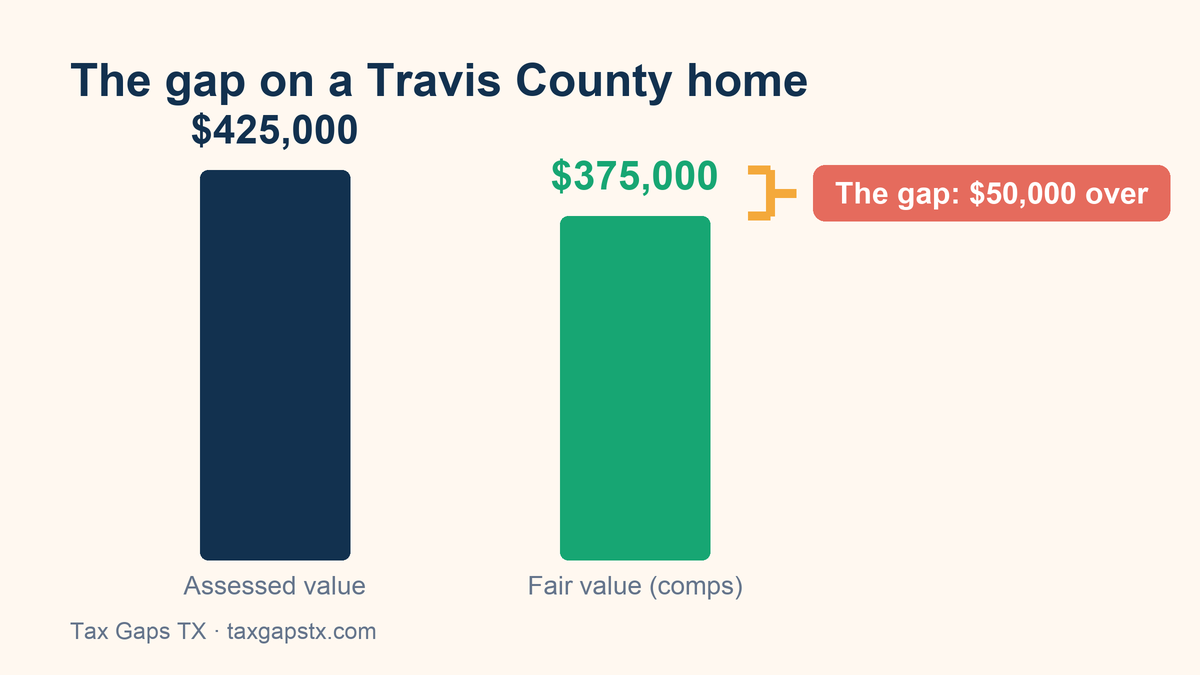
    Assessed value vs fair value — the gap you may be overpaying
    The “gap” is what you may be over-assessed — and the basis for a protest.

    What Does "Equal and Uniform" Mean for Texas Property Taxes?

    In Texas, property taxes are supposed to be fair. “Equal and uniform” is a core principle meaning that your home shouldn’t be appraised for more than similar homes in your area. If your appraisal district (like TCAD in Travis County or DCAD in Dallas County) has valued your property higher than comparable ones, you have the right to protest this over-assessment.

    This right is enshrined in Texas Tax Code Section 41.43(b)(3). It states that an appraisal review board (ARB) must find for the property owner if their property’s appraisal value is greater than the median appraised value of a reasonable number of comparable properties.

    Essentially, you’re looking for the “gap” – the difference between your home’s assessed value and the lower assessed values of similar properties. Finding and proving this gap can save you money on your property taxes year after year.

    How Do You Find Comparable Properties (Comps) for Your Protest?

    Finding the right comparable properties is the heart of an equal and uniform protest. You’re looking for homes that are truly similar to yours in key ways:

    • Location: Ideally, within your immediate neighborhood or subdivision. The closer, the better.
    • Size: Similar square footage (living area).
    • Age: Built around the same time period.
    • Construction: Similar quality and type (e.g., brick, frame).
    • Features: Similar number of bedrooms, bathrooms, garage size, lot size, and amenities like pools or significant upgrades.

    Where do you find this data? Your county appraisal district’s website is a primary source. For example, TCAD and DCAD allow you to search for properties by address or map and view their appraisal history and characteristics. Real estate sites can also provide helpful context, though remember you’re specifically comparing appraisal district values, not necessarily recent sales prices (though sales can inform those values).

    Manually sifting through hundreds of properties can be time-consuming. To quickly identify potential over-assessment and find comparable homes, you can use tools like the free home check at app.taxgapstx.com/check. Just enter your address, and in about a minute, you can see your estimated over-assessment gap for Travis or Dallas county based on public appraisal data and comparable homes assessed for less than yours.

    Building Your Equal and Uniform Case: What Evidence Do You Need?

    Once you’ve identified your potential comps, you need to gather specific evidence to present your case clearly. For each comparable property, collect:

    • Property ID and Address: Essential for the appraisal district to verify.
    • Assessed Value for 2026: The current year’s appraisal value.
    • Key Characteristics: Living square footage, year built, number of beds/baths, lot size, exterior material, and any other significant features.
    • Photos: Visual evidence of the comp’s exterior, especially if it helps illustrate similarity or differences. Google Street View can be useful here.

    Organize this information in a clear format. You’ll want to highlight how your property’s value compares to the median of your chosen comps, demonstrating that your assessment is unfairly high. Remember, you’re arguing for equity based on appraisal values, not necessarily recent sales prices, although sales data can certainly influence an appraisal district’s valuation models.

    Key Steps in the Equal and Uniform Protest Process

    Protesting your property taxes using an equal and uniform argument follows the standard protest timeline:

    1. File Your Protest: The crucial deadline is May 15, or 30 days after your Notice of Appraised Value was mailed to you, whichever is later. Always confirm the exact deadline with your specific county appraisal district.
    2. Informal Review: Many appraisal districts offer an informal review where you can discuss your evidence with an appraiser. This is often the quickest way to resolve your protest if you have a strong case.
    3. Appraisal Review Board (ARB) Hearing: If an informal review doesn’t resolve your protest, you’ll have a formal hearing with the ARB. This is where you present your organized evidence and argue your equal and uniform case.
    4. Binding Arbitration or District Court: If you’re still not satisfied with the ARB’s decision, you may have options like binding arbitration for smaller properties or filing a lawsuit in district court.

    It’s important to be prepared for each step. The more organized and well-documented your equal and uniform comparison is, the better your chances of success.

    DIY Equal and Uniform Protest vs. Professional Help

    Navigating the property tax protest system can feel like a daunting task, especially when building a nuanced equal and uniform case. Here’s a look at the trade-offs:

    Common Challenges and How to Overcome Them

    Even with a strong equal and uniform case, you might encounter some common hurdles:

    • Appraisal District Arguments: The CAD might argue your comps aren’t truly comparable, pointing out differences in condition, lot size, or specific features. Be ready to explain why your chosen comps are indeed relevant.
    • Lack of Perfect Comps: Especially in unique neighborhoods or for custom homes, finding exact matches can be tough. Focus on the closest possible comparables and be prepared to adjust for minor differences in your argument.
    • Time Commitment: Researching, gathering evidence, and attending hearings takes time. If you’re short on time or find the process overwhelming, professional help can be invaluable.

    Remember, the goal is to show a pattern of lower appraisals for similar properties. Even if no single comp is identical, a collection of similar properties assessed lower can build a compelling case. If you need a partner to help identify your gap, prepare evidence, and guide you through the process, consider exploring options like Tax Gaps TX to help you find and protest your over-assessment.

    DIY Equal and Uniform Protest vs. Professional Help

    Feature DIY Equal and Uniform Protest Professional Help (e.g., Tax Gaps TX)
    Time Commitment High (research, data gathering, filing, hearings) Low (professionals handle most of the work)
    Expertise Required Requires understanding tax code, data analysis, and negotiation Leverages specialized knowledge and experience
    Evidence Gathering Manual search for comps, data entry, photo collection Automated tools and expert analysis to identify strongest comps
    Success Rate Varies based on homeowner's preparation and argument Often higher due to specialized expertise and strong evidence packages
    Cost Your time; no direct fee (unless purchasing data) Typically a percentage of tax savings, no savings no fee
    Stress Level Can be high due to complexity and deadlines Significantly lower, as professionals manage the process

    Check your home in minutes

    Tax Gaps TX has a free home check at app.taxgapstx.com/check — enter your address and, in about a minute, see your estimated over-assessment gap for Travis (TCAD) or Dallas (DCAD) county, based on public appraisal data and comparable homes assessed for less than yours. A specialist can then walk you through the evidence and whether it's worth protesting.

    Find your gap free →

    Frequently asked questions

    Can I use sales prices for an equal and uniform protest?

    While recent sales prices can influence a property's market value, equal and uniform protests in Texas primarily focus on comparing your property's assessed value to the assessed values of similar properties. However, sales data can be used to support fair market value arguments, which can be part of a broader protest strategy.

    How many comparable properties (comps) do I need for my protest?

    There's no magic number, but generally, having at least 3 to 5 strong comparable properties provides a solid basis for your equal and uniform argument. The more relevant and similar your comps are, the stronger your case will be.

    What if my comparable properties aren't exactly like my home?

    It's rare to find perfect matches. Focus on finding properties that are as close as possible in terms of location, size, age, and features. Be prepared to explain any minor differences to the appraisal district or ARB, emphasizing why, despite those differences, your property's assessment is still out of line with the median of your chosen comps.

    Does the 10% homestead cap affect equal and uniform protests?

    The 10% homestead cap limits how much the assessed value of a homestead property can increase year-over-year. An equal and uniform protest argues that your property's value should be *lower* than what the appraisal district has assessed, regardless of the cap. If successful, your appraised value (and thus your capped value) could be reduced, potentially leading to greater savings over time. These are distinct but can both benefit homeowners.

    Tax Gaps TX provides general information, not legal, tax, or financial advice. Deadlines and exemption amounts change; confirm current figures with your county appraisal district or the Texas Comptroller.
  • How to Access TCAD Appraisal Data for Your Travis County Property Tax Protest

    How to Access TCAD Appraisal Data for Your Travis County Property Tax Protest

    Short answer: You can access TCAD appraisal data primarily through the Travis Central Appraisal District's website by searching for your property address or account number. This online portal provides property characteristics, valuation history, and often links to sales data. For more detailed comparable sales evidence, especially for an "equal and uniform" protest, you may need to visit the TCAD office or utilize specialized online tools that analyze public records.

    • TCAD website is your primary source for property data.
    • Look for property characteristics, value history, and exemptions.
    • Comparable sales are vital for "equal and uniform" protests.
    • Understand the standard May 15 protest deadline.
    • Specialized tools can help identify your over-assessment gap.
    Assessed value vs fair value — the gap you may be overpaying
    The “gap” is what you may be over-assessed — and the basis for a protest.

    Why Your Property's Appraisal Data Matters for a Protest

    When you receive your annual Notice of Appraised Value from the Travis Central Appraisal District (TCAD), it’s more than just a piece of mail; it’s the starting point for your property tax journey. This notice states TCAD’s opinion of your home’s market value, which directly impacts your tax bill. To successfully protest this value, you need to arm yourself with accurate data.

    A protest typically focuses on one of two main grounds:

    • Market Value: You believe TCAD’s appraised value is higher than what your property would actually sell for on the open market as of January 1st of the tax year.
    • Equal and Uniform: You believe your property is appraised higher than comparable properties in your neighborhood, even if the market value is correct. This is a common and powerful protest ground under Texas Tax Code 41.43(b)(3).

    In either case, solid data is your best friend. It helps you understand TCAD’s assessment and provides the evidence you need to prove your case.

    How to Find Your Property's Data on the TCAD Website

    The quickest way to begin gathering information is by visiting the official Travis Central Appraisal District website at tcad.org. Here’s what to look for:

    1. Property Search: On the TCAD homepage, locate the “Property Search” tool. You can search using your property address, owner name, or your specific TCAD account number.
    2. Property Details: Once you find your property, click on it to view detailed information. This page typically includes:
      • CAD Value: The appraised value assigned by TCAD for the current and previous tax years.
      • Property Characteristics: Details like square footage, number of bedrooms/bathrooms, lot size, year built, and construction type. Verify these carefully for any inaccuracies.
      • Exemptions: Check if your homestead exemption (and any others like over-65 or disabled person) is correctly applied. The Texas homestead cap limits the increase in your appraised value to 10% per year for homesteads, regardless of how much market values rise.
      • Value History: A record of your property’s appraised value over several years.
    3. Map & Photos: Often, the property details page will link to a map and sometimes photos of your property. Review these to ensure they accurately represent your home.

    Reviewing this information is essential to catch any basic errors that might be inflating your appraisal.

    Uncovering Comparable Sales Data for "Equal and Uniform" Protests

    For an “equal and uniform” protest, you need to find similar homes in your area that were appraised at a lower value than yours. This requires identifying comparable properties (comps) that share similar characteristics (size, age, condition, location) but have a lower appraised value per square foot.

    Finding strong comparable sales data can be the most challenging part of the protest process:

    • TCAD Website: While TCAD’s website allows you to search for other properties, obtaining detailed sales prices for residential homes is often limited due to Texas’ non-disclosure laws. You can usually see appraised values, but not necessarily the sale price that led to that value.
    • Visiting the TCAD Office: You can request a “sales packet” or review appraisal records in person at the TCAD office. This can be time-consuming but may provide more detailed information on comparable properties and their assessed values.
    • Specialized Tools: For a quicker and more streamlined way to identify comparable properties that were assessed for less than yours and to see your potential “gap” in Travis or Dallas County, check out Tax Gaps TX’s free home check tool at app.taxgapstx.com/check. Just enter your address to get started, and a specialist can help you understand the evidence.

    Remember, the goal is to find properties that are truly comparable to yours and demonstrate that your appraisal is out of line with the values of similar homes.

    What to Do With the Data: Building Your Protest Case

    Once you’ve gathered your data from TCAD’s website and identified your strongest comparables, it’s time to organize your evidence. Your protest case should be clear, concise, and supported by facts.

    • Organize Your Findings: Create a summary of your property’s characteristics, TCAD’s appraised value, and the details of your chosen comparable properties, including their appraised values and any sales information you have.
    • Highlight Discrepancies: Clearly point out any factual errors in TCAD’s data for your property (e.g., incorrect square footage, features you don’t have).
    • Prepare Evidence: Include printouts from the TCAD website, photos of your home (especially if it has deferred maintenance or is in poorer condition than assessed), and any other supporting documents like repair estimates. For equal and uniform, clearly show how your value per square foot compares to your chosen comps.
    • File Your Protest: Submit your Notice of Protest form to TCAD by the deadline. You can usually do this online, by mail, or in person.
    • Attend Your Hearing: Be prepared to present your evidence to an Appraisal Review Board (ARB) panel. Be polite, factual, and stick to the data. If you are not satisfied with the ARB’s decision, you may have further options like binding arbitration.

    Key Deadlines and Important Reminders for Your 2026 Protest

    Property tax deadlines are firm, and missing them can mean losing your chance to protest for the current year. For the 2026 tax year, the standard protest deadline is May 15 or 30 days after your Notice of Appraised Value is mailed, whichever is later. However, it is absolutely critical to verify this date directly with the Travis Central Appraisal District, as specific situations or legislative changes can affect deadlines.

    A few important reminders:

    • Verify Annually: Exemption amounts and specific deadlines can change each year. Always check the current figures with TCAD or the Texas Comptroller’s office.
    • General Information: This information is for general guidance only and is not legal, tax, or financial advice. We cannot guarantee specific savings for your individual property, as every protest case is unique.
    • Be Proactive: Don’t wait until the last minute. Start gathering your appraisal data and preparing your evidence as soon as you receive your Notice of Appraised Value.

    DIY Data Collection vs. Using a Specialized Service for Your Protest

    Aspect DIY Data Collection Using a Specialized Tool or Service
    Time Investment Significant; involves manual research on TCAD website, possibly office visits and data compilation. Minimal; automated search and analysis of public data to identify potential gaps in minutes.
    Data Comprehensiveness Limited to publicly available TCAD records; sales data can be challenging to find and verify. Accesses broader public records and algorithms to find strongest, most relevant comparables.
    Expertise Needed Understanding tax code, appraisal methods, and property valuation principles is beneficial. No prior expertise needed; tool provides clear insights and guidance on your potential protest.
    Cost Free (your time and effort are the main costs). Free initial home check; potential fee if you opt for full protest service or representation.
    Evidence Quality Requires careful selection and presentation of comps to be persuasive to the ARB. Professionally compiled evidence, optimized for protest effectiveness and often with expert review.

    Check your home in minutes

    Tax Gaps TX has a free home check at app.taxgapstx.com/check — enter your address and, in about a minute, see your estimated over-assessment gap for Travis (TCAD) or Dallas (DCAD) county, based on public appraisal data and comparable homes assessed for less than yours. A specialist can then walk you through the evidence and whether it's worth protesting.

    Find your gap free →

    Frequently asked questions

    Can I access appraisal data for properties other than my own in Travis County?

    Yes, property appraisal data for all properties in Travis County is public record. You can use the TCAD website's property search feature to look up any address or account number within the county to view their assessed values and property characteristics.

    What's the difference between 'market value' and 'appraised value' on my TCAD notice?

    'Market value' is what the appraisal district estimates your property would sell for on the open market as of January 1st. 'Appraised value' is the value your taxes are actually based on, which, for a homestead, cannot increase more than 10% per year due to the homestead cap, even if the market value rises more significantly.

    What happens if I miss the property tax protest deadline for 2026?

    Missing the standard deadline (May 15 or 30 days after your notice, whichever is later) significantly limits your options for the current tax year. In very specific circumstances, such as a clerical error or a disaster, you might have extended deadlines, but generally, it's crucial to protest on time. Always confirm deadlines with TCAD.

    Do I need to pay a fee to protest my property taxes in Travis County?

    No, it is free to file a property tax protest with the Travis Central Appraisal District. There are no fees associated with filing the protest form or attending an Appraisal Review Board (ARB) hearing. However, if you choose services like binding arbitration or legal representation, those would incur additional costs.

    Tax Gaps TX provides general information, not legal, tax, or financial advice. Deadlines and exemption amounts change; confirm current figures with your county appraisal district or the Texas Comptroller.